Okinawa Diaries: No Sharks, No Crowds
Travel diaries: September 7th-9th - island gossip, “serious people” lifeguards, addictive waters—a lovely weekend in Tokashiki.
Good afternoon,
It is rainy on my last day here in Tokashiki,1 but I have no complaints—as long as the ferry operates regularly and I make it to Naha to catch my flight back to Tokyo, which I hope will depart on time—the irreplaceable joys of making summer plans in Japan, when the weather is at its most unpredictable.
This is the second post in my Okinawa diaries series. You can read the first post, which I finished at a hotel room in Naha, here: Okinawa Diaries—En Route to Tokashiki.
After a very short stay in Naha, the main city on mainland Okinawa—which is an entertaining town but might disappoint if you’re expecting to experience the region`s famous subtropical charm— I took the 10 a.m. car ferry to Tokashiki.
The ferry was full, and most passengers, with their small bags, looked like daytrippers. Only 35 minutes away from Naha by fast boat (or 70 minutes by car ferry), Tokashiki attracts many daytrippers, unlike the larger and more remote Okinawa islands like Ishigaki, Iriomote, and Miyako, which mainly cater to multi-day visitors. On weekends, I suspect that the number of day visitors to the island nearly matches its population of 700 residents.
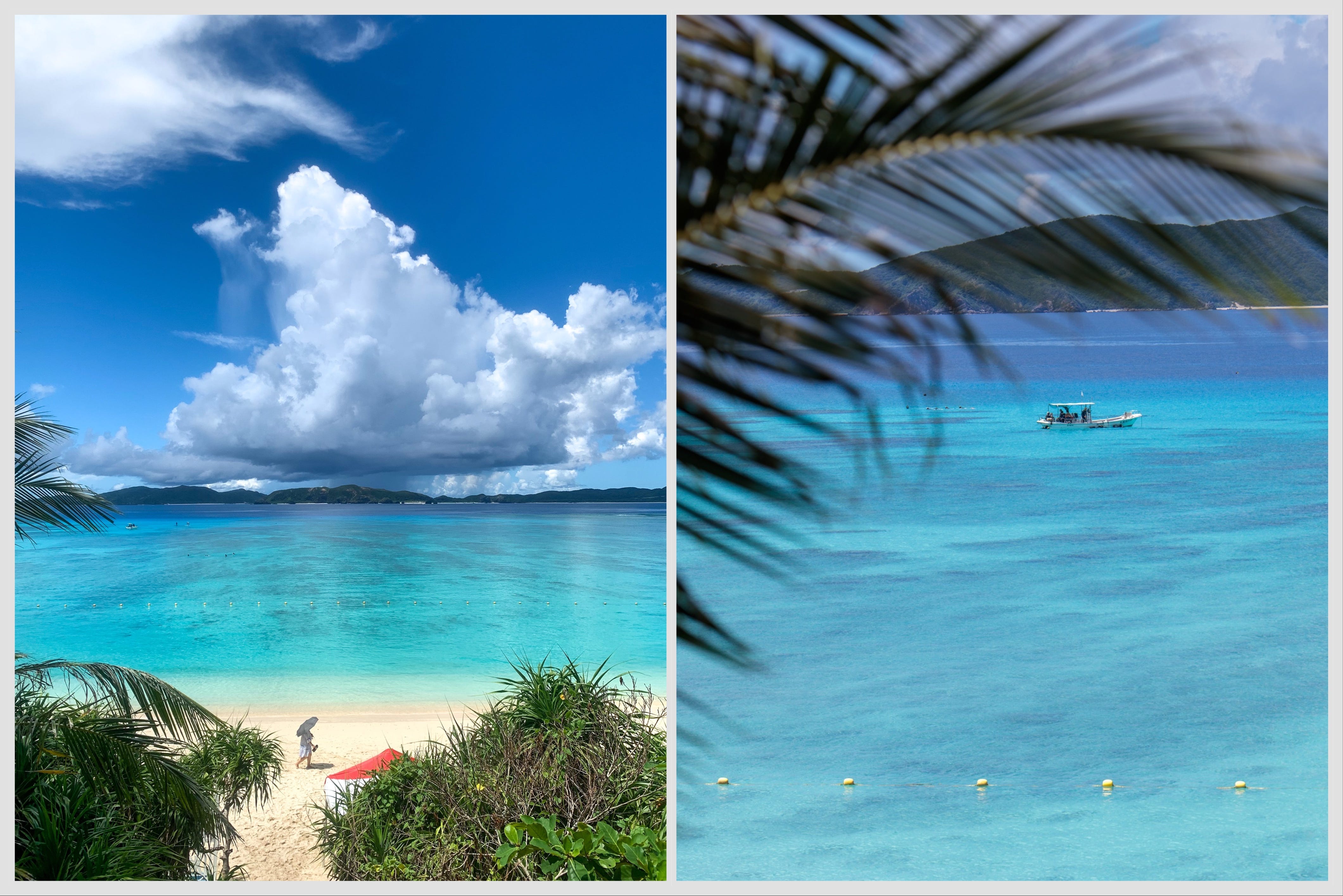
Once the ferry docked at Tokashiki Port, I had just one mission in mind, divided into two acts: drop my bag at the hotel’s reception and sprint to Tokashiku Beach. So, when the receptionist at Hotel Kanaloa told me I could check in and take my bag to my room four hours before the official check-in time—a rare display of flexibility in Japan but a not-so-rare act of kindness—I felt a little disappointed, as it would cause me a whole five-minute delay.
The only thing I struggle with about Tokashiki is the overwhelming sense of urgency created by its almost ridiculously transparent blue waters—similar to how I feel during the autumn colors season in Japan. Every minute away from the beach feels like a waste, and when I am by those “Kerama Blue” waters, I act like a maniac—one moment in the water, the next taking photos from the viewpoint along the beach, feeling frustrated that I cannot perform those two actions simultaneously. Whenever I visit Tokashiku Beach, it takes me a couple of hours to calm down—once I am reassured that the ocean will not go anywhere and will remain just as blue—and start behaving like a more relaxed beach-goer.
So, after a three-year break and exactly 45 minutes after the ferry’s arrival, I was thrilled to reunite with Tokashiku Beach and see that its breathtaking Kerama Blue waters had not disappeared and looked as spectacular as ever.
Despite it being a Saturday with gorgeous weather, there were maybe only ten people on the beach and even fewer in the water. This reminded me of my first visit in September 2018, a year before I moved to Japan, when there was just one other person on the beach—fully dressed (a not uncommon sight on Japanese beaches)—and no one in the water. Despite the unexpected atmosphere and wondering if a shark alert might be keeping people out of the water (!), I remember not being able to resist the delicious color of the ocean and jumping right in. It might not have been the wisest choice, but you would probably have done the same if you had seen those waters.
There are several reasons why Tokashiku, likely one of the most beautiful beaches in Japan—with water quality on par with, if not better than, Thai islands—is often left alone, giving it an almost deserted, Robinson Crusoe-like feel. First, the public bus does not stop at Tokashiku, and reaching it on foot involves a 40-minute, fairly strenuous climb followed by a gentle descent under the harsh Okinawan sun, unless you have your own car. Amenities are also limited, with only one shop/café offering only a few options.
I have also heard that locals are not too pleased with the Tokashiku lifeguards’ strict approach, constantly blowing their whistles and warning people to stay within the designated swimming area.2 Sure, the atmosphere sometimes feels more like an Olympic training camp than a relaxed beach, and like a teacher’s pet, I ask the lifeguards for permission before entering the water to stay on their good side. Still, I believe the lack of crowds and the beautiful cove the beach opens up to make it all worthwhile.
The island’s other main beach, Aharen—which I have heard has a slightly less strict beach guarding regime due to pressure from locals and store owners (a bit of island gossip for you)—attracts significantly more crowds than Tokashiku. Likely, 90% of the people I rode with on the ferry from Naha went to Aharen Beach. It has more of a typical, though not particularly charming, busy beach town vibe. The choice of eateries in Aharen is also much greater than in Tokashiku—one versus ten—making it a more convenient choice for many. Additionally, multiple water sports centers offer snorkeling and kayaking tours to nearby small, uninhabited islands.
Predictably, as I hinted in my first post, I spent most of my time on Tokashiku Island at Tokashiku Beach during this recent visit. After the initial manic phase, I alternated between swimming in a very well-behaved manner and lounging on the second floor of one of the two huts right behind the beach. I also finally started reading Alan Booth’s wonderful and snark-free Japan travelogue, The Roads to Sata: A 2000-Mile Walk Through Japan.
My mornings were once again spent at Sunny Coral, now in a new location right across Hotel Kanaloa, chatting with Rai-san, the owner. He updated me on key Tokashiki news—such as which places had closed or newly opened—shared gossip about Tokashiku lifeguards, and told me about his new business offering e-bike tours around the island.
One evening, thanks to Rai-san’s invitation, I attended a farewell party for a short-term European resident of the island. I met a new islander who had moved from Hokkaido, trading dramatic mountain landscapes and harsh winters for coastal beauty and warm winters, followed by brutally hot summers. I also learned about the island’s housing shortage and how its popularity had surged after the pandemic, with the visitor season now extending well into late October.
On another evening, I dined at the only yakitori place in the area, run by an almost charmingly grumpy cook, while chatting with an Australian traveler whose first entry point to Japan was Tokashiki. They were a little shocked by how rural ‘rural Japan’ could get—a rather extreme level of ruralness that many visitors might not expect to encounter in a country as developed as Japan, and quite different from the stylish rural settings one experiences in the English countryside or Provence in France (maybe a topic for another post). I also tried my hotel’s restaurant, which offered delicious seafood but lacked the cozy atmosphere of the yakitori place due to its bright lights.
On Sunday, I took the customary, very sweaty walk to Aharen Beach, where I had curry for lunch at Octopus Garden. Unfortunately, they were out of the tuna sashimi set I had enjoyed during previous visits. I also hiked up to the Aharen observation deck, taking around fifty photos with results falling short of the spectacular scenery before me. Once again, I found myself hoping for the day when I would finally get used to my new camera setup and no longer miss my faithful Canon 5D Mark II.
So, that was my brief stay in Tokashiki.
After a three-year break, it felt wonderful to revisit this tiny, unpretentious, but gorgeous island, enjoy its FOMO-inducing blue waters, and reconnect with old acquaintances. Whenever I return to Japan after a short visit to Turkey, I feel a bit unsettled, both physically and emotionally, for a few weeks. During these brief transitional periods, a short trip to a familiar place in Japan helps speed up my reintegration. Tokashiki proved to be the perfect spot for this.
As always, thank you for being here. After this unscheduled Okinawa series, I’ll return to my regular schedule with only one monthly letter for regular subscribers, a little less inbox intrusion. You can check out the other subscription options in the newly updated "About" section of Letters from Japan.
I started writing this in Okinawa but finished four days later in Tokyo. While I initially contemplated these series to be similar to the Walking Goto Islands series that I posted in March 2024, given the limited range of activities and sights on Tokashiki, writing about this trip in a regular post style made a little more sense.
In their defense, there was a fatality in the waters of Tokashiku Beach when I was visiting the island in 2020. The water gets deep very quickly.


Mesmerising colours!
The feeling of “urgency” all too familiar … By the way , “no bus stopping “ means no bus around the island or?